

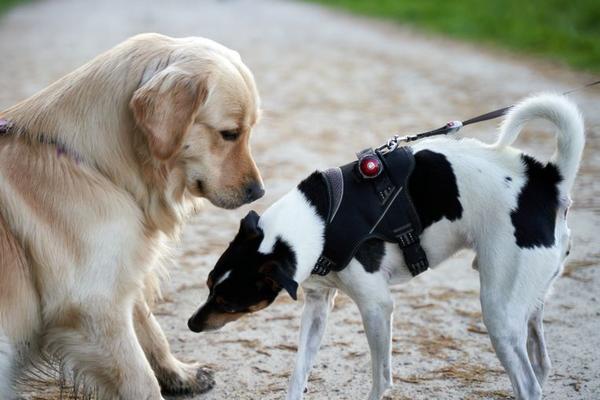
If your dog starts barking and pulling the moment another dog appears, the first question is usually simple: why? The answer is rarely that your dog is “bad” or trying to dominate. Barking at other dogs is often an emotional response to fear, frustration, excitement or feeling trapped on the lead. Understanding what drives the behaviour matters because training works better when it addresses the reason rather than just the noise.
Why Dogs Bark at Other Dogs on Walks
Dog barking on walks can have different causes. One dog may bark because they want another dog to move away, while another may bark because they want to get closer. Both can lunge and pull, yet the emotion underneath is different.
Fear and the Need for More Space
A worried dog may bark to make another dog go away. On lead, they cannot simply retreat at their own pace, so barking and lunging can become a way of creating distance. If the other dog passes or its owner crosses the road, your dog may learn that the reaction “worked,” making it more likely next time.
Watch for signs before the barking starts: turning the head away, lip licking, pinned-back ears, a tucked tail, freezing, hard staring or suddenly refusing treats. Spotting these signals early gives you a chance to move away before your dog can no longer focus.
Frustration and Overexcitement
Some dogs love other dogs so much that being prevented from greeting them creates frustration. A dog that plays happily off lead may still develop dog reactivity barking when restrained. They see another dog, expect interaction, reach the end of the lead and become increasingly excited.
This is common in social dogs that have been allowed to greet almost every dog they meet. Teaching calm observation, rather than arranging a greeting every time, can be an important part of reactive dog training.
Overarousal and Trigger Stacking
A noisy journey, visitors, intense play and a busy park can leave a dog more aroused than usual. By the time another dog appears, their ability to cope may be lower. That helps explain why the same dog may pass calmly one morning and bark the next.
Pain or a Sudden Behaviour Change
If dog barking at dogs appears suddenly, becomes much more intense, or comes with changes in movement, appetite or willingness to be touched, speak to your vet. Pain and illness can reduce tolerance and make a dog more defensive.
Find the Distance Where Your Dog Can Still Cope
Identify the distance at which your dog can notice another dog and still think. They may look at the dog but can also turn back to you, sniff or eat a treat. That is a better place to train than directly beside the trigger.
For example, if your dog usually starts barking when another dog is about ten metres away, begin farther back, perhaps across a wide road or at the edge of an open park. When your dog notices the other dog and stays calm, mark that moment with a cheerful word and give a small, high-value treat. Then move on before tension builds. Repetition can help your dog form a safer, calmer association with seeing other dogs.
What to Do When Another Dog Appears
Choose quieter walking times, use routes with good visibility and avoid narrow paths while your dog is learning. Parked cars, hedges and corners can provide useful visual barriers if another dog appears unexpectedly.
Practise an easy U-turn at home and on calm walks. If you spot a dog ahead, turn away early rather than waiting for barking to begin. Keep the lead secure but avoid deliberately tightening it unless safety requires it, as extra restraint can increase frustration or make a worried dog feel more trapped.
Carry treats your dog values and reward useful behaviours such as checking in, walking past at a comfortable distance, sniffing instead of staring, or choosing to turn away. Natural internal-link topics include dog body language, loose-lead walking and calming enrichment for dogs.
Training for Calmer Responses
Reward Calm Behaviour Before the Explosion
Reactive dog training is most productive while your dog is still able to learn. If they are already barking, lunging and unable to take food, the immediate priority is distance and safety. Once they can think again, training can resume.
A simple exercise is to reward calm noticing. Your dog sees another dog at a manageable distance, you mark the moment, then offer a treat. With repetition, many dogs begin to glance at the other dog and voluntarily look back at you. Keep sessions short.
Do Not Force Close Greetings
Making a nervous dog “face” other dogs at close range can increase fear, while allowing an excited dog to greet every dog can strengthen the expectation that pulling and barking lead to access. Calm, neutral passes are a useful skill. Your dog does not need to meet every dog to have a good walk.
Avoid Punishment for Barking
Shouting, leash jerks and other aversive corrections can add stress or create worse associations with the sight of other dogs. Reward-based training focuses instead on changing the emotional response, teaching alternative behaviours and arranging enough distance for the dog to succeed.
When to Get Professional Help
Seek help from a qualified, reward-based behaviour professional if your dog is snapping, attempting to bite, redirecting onto you, becoming difficult to control, or showing little improvement despite careful management. A veterinary check is also sensible for new or rapidly worsening reactivity.
Frequently Asked Questions
Why does my dog bark at other dogs only when on the lead?
The lead can remove your dog’s ability to move away from something worrying or prevent them from reaching something exciting. That restriction can increase fear or frustration, which is why some dogs react on lead but are calmer in other situations.
Should I let my dog meet other dogs to stop the barking?
Not automatically. If your dog is fearful, a close greeting may be too much. If they are frustrated because they expect to greet everyone, frequent greetings may reinforce that expectation. Calm exposure at a comfortable distance is often more useful.
Will my dog grow out of barking at other dogs?
Some young dogs become calmer with maturity, but repeated barking can also become a well-practised habit. Early management and reward-based training give you a better chance of preventing the pattern from becoming stronger.
How long does it take to reduce dog reactivity barking?
There is no fixed timeline. Progress depends on the cause, health, previous experiences, trigger frequency and how consistently training stays below the reaction threshold. Look for gradual improvements such as recovering faster and checking in with you more often.
Helping Your Dog Feel Safer Around Other Dogs
The goal is to help your dog feel less fearful, frustrated or overwhelmed when another dog appears. Create distance early, notice body language before barking begins, reward calm choices and avoid situations your dog cannot yet handle. With consistent management and humane training, walks can become quieter because your dog has learned a different response.