

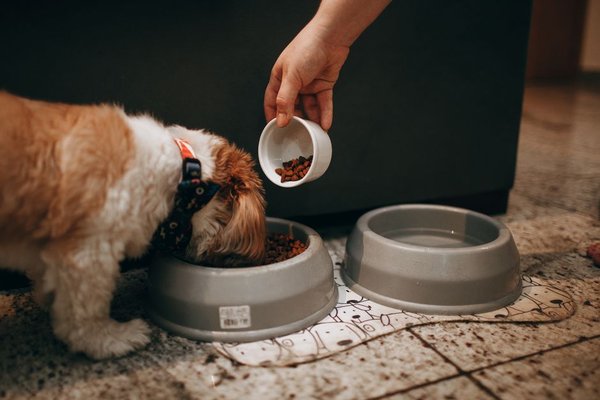
There is no single cup measure that works for every dog. Two dogs at the same weight can need different amounts because age, activity, neuter status, body condition, health, and the calorie density of the food all matter. The best answer to how much should I feed my dog is a starting estimate followed by adjustment. Package directions are useful, but your dog’s weight trend and body shape show whether the portion is actually right.
Start With the Food Label, Not a Generic Cup Amount
Dog foods vary widely in calories. One dry food may provide far more calories per cup than another, while wet food is measured differently. That is why a dog feeding guide based only on “cups per day” can be misleading unless it refers to a specific product.
Check the feeding table and calorie statement on the package. Use the label recommendation for your dog’s current or ideal body weight as a starting point, then divide the daily amount across meals. A useful related topic is choosing a complete and balanced dog food, because portion size only works when the diet is appropriate for the dog’s life stage.
Estimate Daily Calories Before Converting Them to Portions
Veterinary nutrition guidance often starts with resting energy requirement, or RER. A commonly used formula is 70 × body weight in kilograms to the power of 0.75. RER is then adjusted with a life-stage or activity factor to estimate maintenance needs. A typical neutered adult may start around 1.4 to 1.6 times RER, while an inactive or obesity-prone dog may need less. Puppies, working dogs, pregnant dogs, and nursing dogs can need more.
These calculations are estimates, not fixed prescriptions. Individual dogs can fall above or below the predicted range, so body weight and body condition should be monitored as the feeding amount is adjusted.
A practical example
Consider a healthy 20 kg adult dog at an ideal body condition. Its estimated RER is about 662 calories per day. Using a typical neutered-adult factor gives a rough starting range of about 930 to 1,060 calories per day. If its food contains 380 calories per cup, that is roughly 2.4 to 2.8 cups daily before treats. A different food would produce a different cup amount.
Let Body Condition Tell You Whether the Portion Is Working
The scale is useful, but it does not tell the whole story. A dog body condition score looks at fat coverage, the waist, and abdominal tuck. On the common nine-point system, an ideal score is generally around 4 to 5 out of 9. You should usually be able to feel the ribs without pressing through a heavy fat layer, see a waist from above, and notice an upward abdominal tuck from the side.
If your dog is gradually gaining weight and moving above an ideal body condition, the current portion is probably too generous even if it matches the bag. If weight is dropping unexpectedly or the dog looks too lean, the portion may be too small or a medical issue may be involved. Recheck weight and condition after a few weeks when you change dog portion sizes.
Age, Activity, and Life Stage Change How Much Dog Food Per Day Is Appropriate
Puppies need food formulated for growth and usually have higher calorie needs relative to body size than adults. Large- and giant-breed puppies also need carefully controlled growth. Adult dogs may be more predictable, but an athletic dog that runs or works daily can need much more energy than a same-size dog with a quiet indoor routine.
Older dogs vary too. Some become less active and need fewer calories, while others lose weight or muscle because of aging or disease. Pregnancy, lactation, recovery from illness, and chronic conditions can also change nutritional needs enough that a veterinarian should guide the feeding plan. Feeding puppies by age and breed size is another useful topic for owners of growing dogs.
Count Treats, Chews, and Table Food
Owners often measure the main meal carefully and overlook calories between meals. Training treats, dental chews, peanut butter used for medication, leftovers, and food-dispensing toys all count. Veterinary nutrition guidance commonly recommends keeping treats and other non-complete foods to about 10% or less of total daily calories so they do not crowd out balanced nutrition.
If your dog needs 900 calories per day, keeping extras near 90 calories leaves most of the calorie budget for the complete diet. For frequent training rewards, using part of the measured daily kibble allowance as treats can simplify portion control.
Measure Consistently and Adjust Gradually
A kitchen scale is the most precise way to measure dry food because cup measurements can vary. If you use cups, use the same level measuring cup each time. Feed measured meals rather than continually topping up the bowl when weight control is a concern.
When you need to change the amount, make a modest adjustment and watch the trend. The right portion is the amount that supports a healthy body condition, appropriate stable weight, good energy, and normal digestion. A guide to healthy dog weight and body condition can help owners learn what to look for at home.
When to Ask Your Veterinarian for a Specific Amount
Get individual advice if your dog is a puppy, pregnant or nursing, underweight, significantly overweight, very athletic, elderly with muscle loss, or living with a medical condition. Sudden weight change, persistent hunger, reduced appetite, vomiting, diarrhea, or increased thirst also deserve veterinary attention rather than a simple portion change.
Frequently Asked Questions
How many times a day should I feed my dog?
Many healthy adult dogs do well with two measured meals a day. Puppies usually need more frequent meals, with the schedule changing as they mature. Medical conditions can also affect meal timing.
Should I feed my dog according to current weight or ideal weight?
For a dog at a healthy body condition, current weight is a reasonable starting point. If the dog is overweight or underweight, feeding strictly from current weight can be misleading. A veterinarian can help set a calorie target based on ideal body condition.
Are feeding instructions on the bag accurate?
They are useful starting guidelines, not guarantees. Dogs vary in metabolism and activity, and calorie density differs among foods. Start with the label, then adjust according to weight, body condition, activity, and veterinary guidance.
How do I know if I am feeding too much?
Gradual weight gain, loss of a visible waist, difficulty feeling the ribs, and a rising body condition score are common clues that intake exceeds needs. Include treats and chews when reviewing the total. If weight changes quickly or unexpectedly, arrange a veterinary check.
Find the Portion That Fits Your Dog
The most reliable approach combines the food’s feeding guide, an estimated calorie target, and your dog’s real-world response. Measure food consistently, count extras, and reassess weight and body condition over time. That turns “how much should I feed my dog?” from a guess into a practical feeding plan that can change as your dog’s needs change.